title: Are Drive-Ins Dead? Why Genre Fans Still Love the Experience

The screen flickers. The night air cools. Somewhere in the dark, a creature is getting closer, and all around you, a crowd leans in.
That’s the drive-in difference. It isn’t just a way to watch a movie. It’s a night out, a shared ritual and, for genre fans, a front-row seat to the strange. Drive-ins may no longer dominate moviegoing, but they still make room for the kind of communal movie experience that horror, science fiction and creature features do so well.
Not dead. Just a different kind of movie night.
The drive-in’s golden age is long past. The United Drive-In Theatre Owners Association (UDITOA) counted 283 U.S. drive-ins in 2024. Its 2025 statistics list 280 theaters and 480 screens. That’s a fraction of the estimated 4,063 drive-ins operating in 1958-but it’s hardly a vanishing act.
The numbers describe a smaller, more specialized exhibition scene. They don’t measure the hold the format still has on movie lovers. Drive-ins have weather to contend with, seasons to work around and plenty of land to maintain. They’ve also got something streaming can’t offer: a big screen under an actual night sky, with other people there to share the moment.
The pandemic briefly put that difference in sharp relief. CNN reported that drive-ins accounted for 85% of U.S. box office revenue from late March to mid-August 2020, compared with 2.9% during the same period in 2019. That surge didn’t make outdoor theaters the new normal. It did remind audiences what they can do especially well: turn a screening into an occasion.
UDITOA notes that its figures are compiled from multiple sources and can shift as theaters open, close or change status. The exact count may move. The appeal is easier to spot.
Why monsters belong outdoors
Horror thrives on anticipation. A creak in the house. A shape at the tree line. The monster that could be anywhere just outside the light.
At a drive-in, the darkness isn’t confined to the screen. It surrounds the audience. Beyond the movie, there’s open air, night sounds and a sea of cars filled with people reacting together. You can watch a monster attack on screen while the world outside your windshield stays deliciously hard to read.
That setting makes creature features feel right at home. A giant beast on an outdoor screen has room to loom. A UFO can hover above the audience. A storm can rumble through the story while the real sky hangs overhead. The drive-in becomes part of the genre’s visual language: a distant screen, a dark field and just enough space for the imagination to start misbehaving.
And horror fans don’t have to sit perfectly still in a hushed room to enjoy the show. They can gasp, laugh, call out to the doomed character making a terrible decision, and hear the crowd answer back. That response becomes part of the entertainment. The scare lands, and the whole lot reacts.
For an independent film production company making genre movies, that kind of audience connection is a useful reminder: spectacle matters, but so does the room, or field, in which people experience it.
The crowd is part of the feature
Drive-in culture offers a distinctive balance: shared excitement with room to be yourself. Moviegoers can watch from the car, spread out on folding chairs or settle in with blankets and snacks. Friends talk before the show. Families bring the kids. A stranger’s laugh at exactly the right moment becomes a tiny piece of the evening.
It’s communal without being formal. The audience can turn up in costumes for a horror marathon, catch a double feature, or show up just to have a night outdoors with friends. The movie is the main event, but the atmosphere starts well before the first frame.
That helps explain why nostalgia is only part of the draw. Yes, drive-ins carry the romance of another era: marquee lights, tinny speakers and a screen glowing over the lot. But their appeal is also immediate. People want an experience they can take part in, not just another title to scroll past.
For genre fans, participation comes naturally. A cult audience brings its own rituals, references and enthusiasm. Put a monster movie on a giant screen and the crowd doesn’t just consume the story. It celebrates it.

Drive-in culture, translated for the screen
Drive-in movies have always made space for big feelings and bold premises. The format’s history is tied to horror and science fiction as well as romance, comedy and family entertainment. Those genres understand that a strong image can hook an audience fast: a creature in the water, a strange light over the town, a couple stealing a moment beneath the screen.
That spirit fits the way Andromeda Studios approaches storytelling. Our vintage pulp-inspired visual identity leans into confident lines, expressive color and images with enough drama to make you look twice. It’s a visual language built for heightened stories, and for the bold, tactile energy of classic genre posters.
Our project Drive-In the Musical brings that setting directly into the story. Set in 1957, the musical follows Hollywood starlet Baby Rogers as she escapes her controlling mother and finds romance, friendship and a chance at a more ordinary life at a small-town drive-in. The drive-in is more than a nostalgic backdrop. It’s where the characters meet, take chances and begin to discover who they want to be.
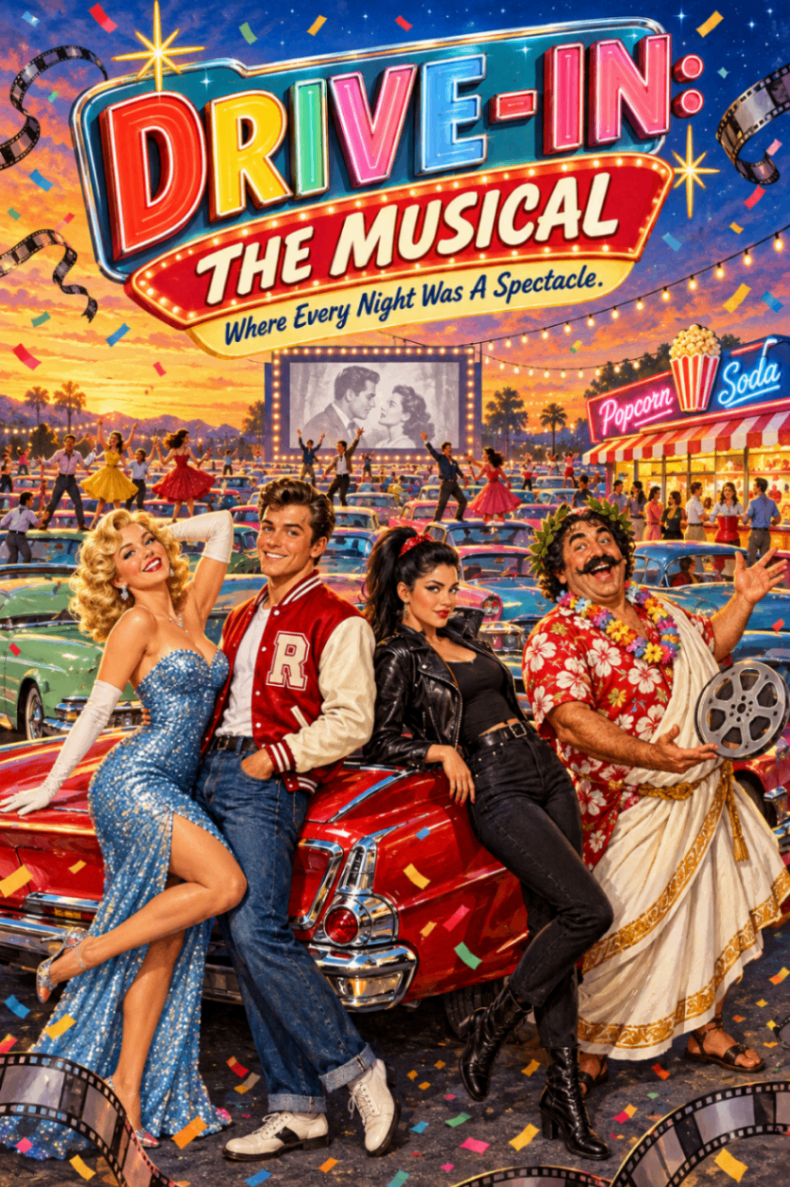
The premise is a reminder that drive-in culture isn’t limited to one genre. The same screen that gives a creature feature its eerie scale can frame a first kiss, a dance number or a moment of rebellion. Genre filmmaking works best when a setting does more than look good. Here, the drive-in brings people together and gives the characters somewhere to make a change.
It also connects to a broader creative opportunity. For filmmakers exploring sci fi film production, horror or a period story, the drive-in can function as a setting, a story engine or an event around which characters collide. In digital media production, where audiences can watch almost anywhere, a distinctive cinematic world gives a story its own identity. Sometimes that world starts with a screen in a field.
A living tradition, not a museum piece
Drive-ins are not on track to reclaim their mid-century peak. They don’t have to. Their future can be smaller and still matter: a local venue hosting a summer crowd, a late-night horror screening, a repertory double feature or a musical romance that turns an old movie lot into a place of possibility.
For audiences, the invitation is simple. Find a nearby outdoor screening, bring a friend, pack a blanket and let the evening unfold around the movie. For independent filmmakers, it’s worth remembering what drive-ins make visible: people still want to gather around stories that scare them, delight them and give them something to talk about on the way home.
The drive-in isn’t dead. It’s still glowing out there. And when the right movie hits the screen, the whole lot leans in.
Explore Andromeda Studios’ slate, including Drive-In the Musical, or get in touch to start a conversation.